


GOLD RINGS


The Most Expensive Jewelry Ever Sold
There are two kinds of number in this subject, and only one of them is real.
The first comes from auction rooms, where two people bid against each other in public and the price is whatever the losing bidder stopped at. Those figures are facts. The second comes from interviews and press releases, gets copied between articles until nobody remembers the source, and is quoted with the same confidence as the first. Almost every chain price you've read is the second kind.
Below we'll go through the records that actually happened, why colored diamonds sit at the top of them, and what genuinely decides the price of a chain once you strip out the folklore.
Jump to:
- What the World Records Actually Are
- Why Colored Diamonds Beat White Ones
- The Chains People Ask About
- Why Nobody Can Tell You What a Chain Is Worth
- What Actually Makes a Chain Expensive
- Where We Fit
- FAQs
What the World Records Actually Are
These are auction results. Somebody paid them.
The Pink Star, $71.2 million
A 59.60 carat fancy vivid pink diamond, and the highest price ever paid for any jewel at auction. Sold in 2017 in Hong Kong.
The Oppenheimer Blue, $57.5 million
A 14.62 carat fancy vivid blue, named for the family that ran De Beers for most of the twentieth century. Sold in 2016.
Apollo and Artemis, $57.4 million
A pair of earrings sold as two lots on the same evening in 2017, a blue diamond and a pink, bought by the same buyer and reunited.
The Winston Pink Legacy, $50.4 million
An 18.96 carat vivid pink, sold in 2018 and renamed by its buyer within minutes of the hammer falling.
The Blue Moon of Josephine, $48.4 million
A 12.03 carat vivid blue, bought in 2015 by a father who named it after his daughter.
Five stones, none of them a chain, and not a gram of gold among the headline figures. Which is the first clue about where value actually sits in jewelry.
Why Colored Diamonds Beat White Ones
Every piece on that list is a colored diamond, and that isn't a coincidence.
A colorless diamond is graded on the absence of color. The scale runs from D down, and the very best are rare but not vanishingly so. There is a functioning market in them, with thousands of comparable stones, which means there's a price per carat everyone roughly agrees on.
A vivid pink or blue is a geological accident. Blue comes from trace boron, pink from a distortion in the crystal lattice under pressure, and neither happened often. At the very top of that market you're not looking at thousands of stones, you're looking at a few dozen that exist at all. When two people want the same one, there's no second example to go and buy instead. That's what produces a $71 million hammer price.
Size multiplies it rather than adding to it. Rarity compounds with weight, so a 60 carat vivid pink isn't sixty times a one carat vivid pink. It's in a different category entirely.
The Chains People Ask About
This is where the second kind of number starts.
Pharrell's N.E.R.D chain by Jacob the Jeweler is the piece usually named as the most expensive, at a reported figure of around $1 million. Gucci Mane's twin panther chain, Kanye West's Horus pendant and Quavo's enameled Ratatouille piece all appear on the same lists at a few hundred thousand each. We've run through the full rundown in our guide to the most expensive chains in the world, so this page won't repeat it.
What's worth pulling out here is one detail that gets missed. Drake's OVO owl is reported at around $120,000, which makes it comfortably the cheapest piece that appears on most of these lists, and by a distance the most famous. Fame and price have almost nothing to do with each other here.
And then there's the bigger problem with all of those figures.
Why Nobody Can Tell You What a Chain Is Worth
None of those numbers came from a sale.
They came from an interview, a jeweler's press release, or an estimate someone made by looking at a photograph. From there they went into a blog post, then into ten more blog posts, each one citing the last. Follow any of these numbers back far enough and you usually arrive at one person saying a number out loud, once.
Which is why the same chain turns up at wildly different figures depending on which article you land on, and every one of them states its number with total confidence. Nobody checks, because there's nothing to check against.
Auction results are different in a specific way. Two people who wanted the same object bid against each other in public, and the price is whatever the losing bidder stopped at. That number is real because somebody actually paid it.
A custom chain has no second bidder. It has a commission price, which reflects what one person agreed to pay one jeweler on one day, and that's assuming the reported figure is the commission price and not a guess. Second-hand, most of them are worth considerably less than the number attached to them. Custom pieces are hard to resell, the stones are usually set for effect rather than grade, and the gold is worth its weight and karat whatever the design is.
So treat every chain figure you read as folklore. Good folklore, but folklore.
What Actually Makes a Chain Expensive
Strip out the celebrity and the story, and a chain's cost comes down to four things.
1. Weight. Gold is sold by mass. A 12mm Cuban link holds several times the metal of a 4mm one, and that difference is most of the price difference before anything else is considered. It's the least glamorous factor and the biggest.
2. Karat. 10K is 41.7% gold, 14K is 58.3%, 18K is 75%, 24K is pure. Raise the karat and you raise the metal cost for the same weight, proportionally. The number stamped on a clasp is a purity statement, and what the stamps mean is the single most useful thing to know when someone hands you a price.
3. Stones, and how they're set. This is where the real money goes on iced pieces. Not the stones themselves so much as the labor: every stone is set individually, by hand, and a fully iced chain can hold several hundred of them. Prong setting costs more than channel setting because more of each stone is left exposed, which takes longer and allows less margin for error.
You can see the effect of that labor without leaving our own range. A half iced Cuban and a fully iced one are the same links in the same finish. The difference in price is almost entirely the difference in setting work.
4. Whose name is on it. A commission from a jeweler with a reputation carries a premium that has nothing to do with materials. That's not a criticism. It's just worth knowing which part of the invoice is metal and which part is signature.
Everything else is finishing. Worth noting that plated and solid gold can look identical across a room and differ by a factor of twenty in price, which is why what gold plated actually means is worth ten minutes, and that 925 on a clasp tells you what you're holding better than any photograph will. If you want the pure metal version of this question, how much a gold bar is worth works it out from scratch.
Where We Fit
We're not going to pretend we're on that list.
What we will say is that most of what people respond to in an expensive chain is the setting and the light, not the certificate. Nobody across a room can tell a natural diamond from a well-set stone. What they can tell is whether the stones sit flat, whether the links catch light evenly, and whether the thing looks like it belongs on the person wearing it. So that's where the work goes.
The Prong Link Iced Cuban is handset with hundreds of AAA-grade stones in sharp, clean-cut links designed to sit flat on the neckline. The Tennis Chain uses a four-prong 18k gold setting that protects each stone and maximizes how much light it throws back. Both carry our snap-proof clasp and scratch-resistant protection.
If you want presence rather than shine, the 12mm Cuban is the heaviest link we make. And the Iced North Star is for anyone who'd rather their jewelry said something than simply cost something.
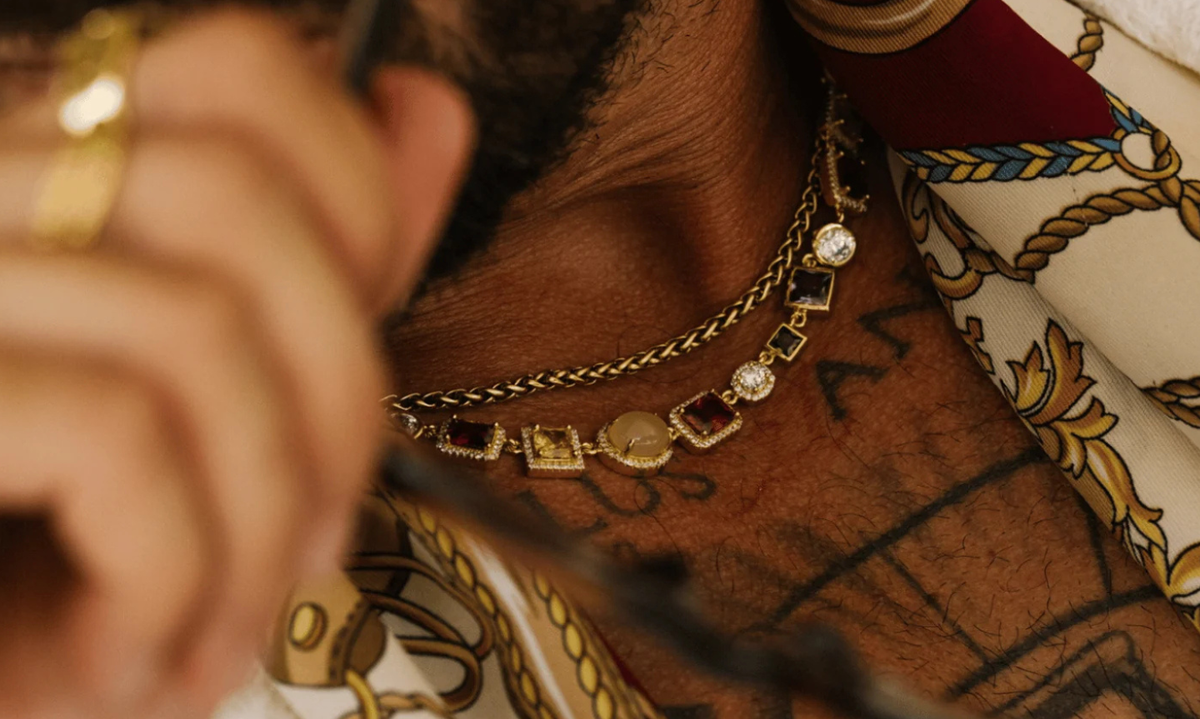
On the stone side, the Sapphire Gemstone Necklace and the Iced Gemstone Necklace are the pieces in our range that read most like the ones at the top of this page, for reasons of setting rather than budget.
FAQs
What is the most expensive piece of jewelry ever sold?
The Pink Star diamond, a 59.60 carat fancy vivid pink, sold at auction in 2017 for $71.2 million. That figure is real in a way most jewelry prices aren't, because two bidders competed for it in public and the price is where the losing bidder stopped.
What is the most expensive chain in hip hop?
Pharrell's N.E.R.D chain by Jacob the Jeweler is the piece most often named, at a reported figure of around $1 million. Treat that and every other chain figure as folklore rather than fact, for the reasons set out above. Our guide to the most expensive chains in the world runs through the full list.
How much is Drake's owl chain worth?
The OVO owl is usually reported at around $120,000. It's the most famous piece on almost every list of expensive chains and one of the cheapest on it, which tells you most of what you need to know about the relationship between fame and price.
Why are pink and blue diamonds more expensive than white ones?
Scarcity. Colorless diamonds are graded on the absence of color, and the very best are rare but not vanishingly so. A vivid pink or blue is a geological accident that happened a handful of times, so the top of that market is a few dozen stones rather than a few thousand.
Is an expensive chain a good investment?
Generally no. Custom pieces are hard to resell, stones in them are usually set for effect rather than graded for resale, and the gold is worth its weight and karat regardless of the design. The metal holds value; the commission and the name on it usually don't.
How can I tell what a chain is actually made of?
The stamp on the clasp. A karat mark like 14K or 18K on its own means solid gold. GP, GEP or HGE means a gold layer over something else. 925 means sterling silver. No stamp at all is itself an answer.
Why do the same chains get quoted at different prices?
Because none of those numbers came from a sale. They came from an interview, a press release, or someone's estimate from a photograph, and then got copied between articles. Follow any of them back far enough and you usually reach one person saying a number out loud, once.
Find the One That's Yours
The records at the top of this page are geology and scarcity. The chain figures below them are stories. Knowing which is which is most of what this subject has to teach.
What's left is the part that matters: how a piece is made, and whether it looks right on you. Have a look through the iced range or the chains if you're deciding what's yours.
Read more
Gold or Silver Jewelry: Which One Suits You?
Most advice on this treats it like a personality test. It isn't. Both metals suit most men, the question worth asking is which piece rather than which metal, and wearing the two together now reads ...
Leer más
What Is White Gold? Karats, Stamps and the Catch
White gold is real gold, alloyed with pale metals and then plated in rhodium to make it properly white. The gold is the object; the colour you fell for is a coating a fraction of a micron thick, an...
Leer más
Dejar un comentario
Este sitio está protegido por hCaptcha y se aplican la Política de privacidad de hCaptcha y los Términos del servicio.