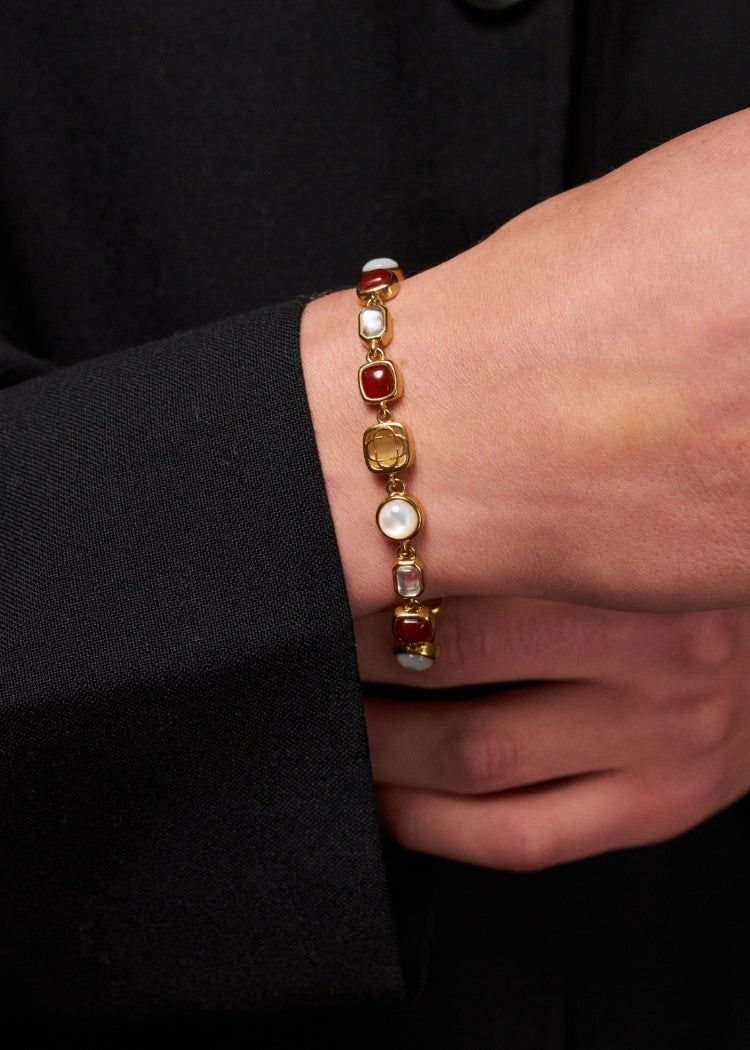
GEMSTONE BRACELETS
SHOP NOW



Cart
Your cart is empty
Your gifting options
Make your gift extra special with our luxury packaging options. Select a gift bag, gift box or a combination to create the perfect presentation.

Luxury Gift Box, Gift Bag & Wrapping Kit ($8.99)
Includes: CRAFTD Luxury Gift Box, Gift Bag, Tissue Wrapping Paper & Ribbon

Meaning Card ($2.99)
Add more meaning to your gift with a meaning card included with your order.
15 variations available

Luxury Gift Box ($5.99)
Choose your option
To My Boyfriend

To My Husband

To My Soulmate

To My Son

To My Grandson

To My Brother

To My True Friend

To My Dad

A Symbol Of Strength

A Symbol Of Faith

A Symbol Of Protection

A Symbol of Luck

A Symbol Of Safe Travel

A Symbol Of Self Belief

A Symbol Of Adventure

Gold plated means a base metal with a thin layer of real gold bonded to the surface. The gold is real. The piece is not solid gold. Those two facts sit together more comfortably than most people expect.
What the phrase doesn't tell you is how thin that layer is or what's underneath it, and those are the two things that decide whether a piece lasts a decade or a season. Two chains can both be honestly labeled gold plated and be nothing alike to own.
Below we'll cover what the term means, whether it counts as real gold, what American law actually requires, and what every other plating term on the market is really telling you.
Jump to:
A base metal underneath, real gold over the top. It's the same 18 karat gold you'd find in a solid piece, just laid on in a layer measured in microns rather than making up the whole object.
The word people get stuck on is "plated", which they hear as "fake". It isn't. What it is, is imprecise. The term describes a method, and on its own it says nothing about quantity. That's the gap this page exists to close.
Yes, and that's a narrower answer than it sounds.
The layer on the surface is genuine gold, usually 14 or 18 karat. It isn't gold-colored paint and it isn't an imitation. If a listing says 18K gold plated, the gold on it really is 18 karat.
But "real gold" and "solid gold" are two different claims, and the gap between them is where a lot of misleading listings live. A plated piece contains a tiny fraction of a gram of gold. Its material value is close to nothing, and it will never be worth reselling for the metal. What you're actually buying is the look and the wear, which is a perfectly reasonable thing to buy, as long as nobody has implied you're buying an investment.
Here's the part that changes how you read a listing.
In the United States these terms aren't a free-for-all. The Federal Trade Commission's Jewelry Guides set out what a seller is allowed to call things, and there are real numbers behind them. For anything labeled gold electroplate, the gold has to be at least 10 karat and at least 0.175 microns thick.
Read that number again. 0.175 microns is roughly seven millionths of an inch. It is the thickness at which a piece can legally be sold to you as gold plated, and a piece built to exactly that spec will wear through at the clasp in weeks.
So the useful conclusion is the opposite of what you'd expect from a regulation existing. The rule doesn't protect you, because the floor is set so low that clearing it proves almost nothing. Plenty of jewelry on the American market is honestly and legally described as gold plated while carrying a layer of gold you could wear off in a season.
The numbers that do mean something sit further up the same rulebook. Heavy gold electroplate has to reach 2.5 microns, more than fourteen times the minimum. Vermeil has to reach 2.5 microns and sit on a solid sterling silver base. Gold filled has to be mechanically bonded and make up at least a twentieth of the item's total weight.
The lesson is not that American labeling is dishonest. It's that "gold plated" is the one term on the list that tells you nothing, precisely because its bar is on the floor.
The process is electroplating, and it's older than most people expect. The Italian chemist Luigi Brugnatelli first plated gold onto metal using an early battery in 1805.
Three stages, and the middle one matters more than anyone tells you.
The base is cleaned. Any oil or residue left on the surface stops the gold bonding evenly, so pieces are cleaned thoroughly, usually ultrasonically, before anything else happens.
A barrier layer goes on. This sits between the base metal and the gold, stopping the two migrating into each other and giving the gold something even to bond to. Industry-wide, that barrier layer is very often nickel, and this is worth knowing, because it's the single most common reason people react to plated jewelry. Gold itself is inert and almost nobody reacts to it. The nickel sitting underneath is a different story, and once a thin gold layer wears through, that's what reaches skin.
The gold goes on last. The piece is suspended in a solution containing dissolved gold, an electric current runs through it, and the gold bonds to the surface. How long it sits there is what decides the thickness.
Ours uses rhodium as the barrier layer rather than nickel, which we'll come back to below, but the point holds generally: with plated jewelry, what's under the gold is doing more work than the gold is.
Ignore the adjectives on the listing. Two things decide whether a plated piece is any good.
How thick the gold layer is. Measured in microns, thousandths of a millimeter. The legal floor is 0.175. Standard plating on the market is often around 0.5, which is genuinely thin: enough to look right in a photograph and on the first few wears, not enough to survive years of contact. Vermeil sits at 2.5 and up. More gold on top means more to wear through before anything underneath shows.
What the base metal is. This is the one that catches people out. Brass and copper are cheap, and both react with skin and air. Once the gold thins at a clasp or an edge, the base is exposed, and that's when a piece starts marking skin and looking wrong. A stainless steel or sterling silver core doesn't do that, because neither corrodes.
Get both right and a plated piece lasts for years. Get both wrong and you have a season. Everything else, including the price, follows from those two numbers, and a seller who won't tell you either has told you something anyway.
Every term below describes gold on top of something else. They are not equivalent, and in the US some of them carry a federal standard while others carry nothing at all.
The pattern: the more specific the language, the more likely there's something behind it. Vague superlatives fill the space where a number would go. If you want to go further on what the stamps themselves mean, our guide to the symbols stamped on jewelry covers the full set.
The gold won't. Gold doesn't tarnish, rust or react, which is why it's been used for jewelry for thousands of years. What can tarnish is whatever sits underneath it.
On a piece built over brass or copper, once the gold thins at the points that take the most contact, the base metal is exposed to air and skin. That's when a chain starts looking dull in patches and when skin starts marking.
Green skin is copper. It's a reaction between copper in the base alloy and the acids in your skin, it's harmless, and it washes off. It also tells you something specific: the plating has worn through in that spot. It's not a sign the piece is dirty, and cleaning it harder won't help.
On a stainless steel core, none of this happens, because steel doesn't corrode and there's no copper in it to react. That's the practical case for paying attention to the base metal rather than the marketing. Our guide to whether gold plating tarnishes goes further into what to expect over time, and how to clean a gold chain covers what actually protects a plated finish.
It depends entirely on the two numbers, and the honest answer splits into two.
Thin gold over brass is not worth buying unless you want it for a season and you know that going in. It'll look right for a few weeks, thin at the clasp, mark your skin, and end up in a drawer. The low price is the whole product.
Real 18 karat gold over a stable core is a different purchase entirely. You get the look and the weight of gold at a fraction of the cost of solid, on something you can wear daily for years. For most men, most of the time, that's the sensible buy. Solid gold is soft, expensive, and mostly overkill for a chain you want to wear without thinking about it.
Worth keeping in perspective: across a room, plated and solid gold look the same, and most of what reads as expensive on a chain is the weight, the setting and the light rather than the metal underneath. Rings are the hardest test of the lot, since a hand takes more abrasion in a week than a neck does in a year, and how to clean gold rings goes into why a plated ring behaves differently from a plated chain.
The mistake isn't buying plated. It's buying plated without asking what's underneath, which for a long time nobody has made easy. How long a well-made plated piece actually lasts is covered properly in how long gold plating lasts.
People ask us this directly, so here's the plain answer: yes, and in two forms, neither of which is solid gold.
Our gold pieces are real 18 karat gold over a solid 316L stainless steel core, with a layer of rhodium between the two rather than the nickel used across much of the industry. Steel doesn't rust, corrode or tarnish, so there's no reactive base metal waiting underneath, and no copper to mark skin if the finish ever thins. That combination is the reason our gold pieces behave the way they do in daily wear, and it's a deliberate choice rather than a coincidence of cost.
Where a stone needs setting, the front of a piece uses an alloy core, because a claw setting needs a metal that can be worked and closed, but the structural parts and anything in prolonged skin contact stay steel.
Separately, we make gold vermeil, which is 18 karat gold over solid sterling silver to the 2.5 micron standard, for anyone who wants a precious metal underneath rather than steel.
Two routes, both with a real answer to the two questions this page is about. What we don't do is describe either one as solid gold, because neither is. If you want the wider view on what gold has meant to people for the last few thousand years, what gold represents is a good detour, and the types of men's chains guide covers which style to put it on.
The layer on the surface is real gold, usually 14 or 18 karat. It isn't gold-colored paint and it isn't an imitation. It isn't solid gold either, and the amount is small enough that a plated piece has almost no material value. You're buying the look and the wear rather than the metal.
A base metal with a thin layer of real gold bonded to the surface. In the US the FTC sets a floor for the term: at least 10 karat gold, and at least 0.175 microns thick if it was applied by electroplating. That floor is low enough that meeting it tells you very little.
0.175 microns of fine gold for anything labeled gold electroplate, under the FTC Jewelry Guides. Heavy gold electroplate has to reach 2.5 microns, and vermeil has to reach 2.5 microns over a solid sterling silver base. Standard plating on the market often sits around 0.5 microns, which is legal and still thin.
Nothing defined. The FTC Jewelry Guides name gold plate, gold electroplate, heavy gold electroplate, gold filled, rolled gold plate and gold overlay. Gold clad is not among them. A seller using it instead of a term with a standard behind it has made a choice worth noticing.
Yes, in two forms. Our gold pieces are real 18 karat gold over a solid 316L stainless steel core, with rhodium between the two rather than the nickel much of the industry uses. We also make gold vermeil, which is 18 karat gold over solid sterling silver to the 2.5 micron standard. Neither is solid gold, and we don't describe them that way.
Thickness and method. Gold plating bonds a thin layer electrically. Gold filled bonds a much thicker layer mechanically, and under FTC rules the gold has to be at least 1/20th of the item's total weight. Gold filled lasts longer and costs more.
GP is gold plated, GEP is gold electroplate, and HGE is heavy gold electroplate. In the US only the last of those carries a meaningful number: 2.5 microns, against 0.175 for plain electroplate. So HGE is the one worth seeing on a stamp.
Only if the base metal contains copper and the gold has worn through. The gold itself never causes it. Green marking is a copper reaction, it's harmless, and it's a sign the plating has thinned in that spot. A stainless steel core doesn't do it.
If it's real gold over a stable core like stainless steel, yes, and it's the sensible way to wear gold daily without solid gold prices. If it's thin gold over brass, you're buying a few weeks of looking right. The words on the listing won't separate the two for you, but the micron figure and the base metal will.
Gold plated isn't a warning label and it isn't a promise. It's a method, with a legal floor low enough that the word alone can't be trusted. Ask for the micron figure and the base metal, and the answer stops being vague very quickly.
Have a look through the men's gold collection if you're deciding what to buy.
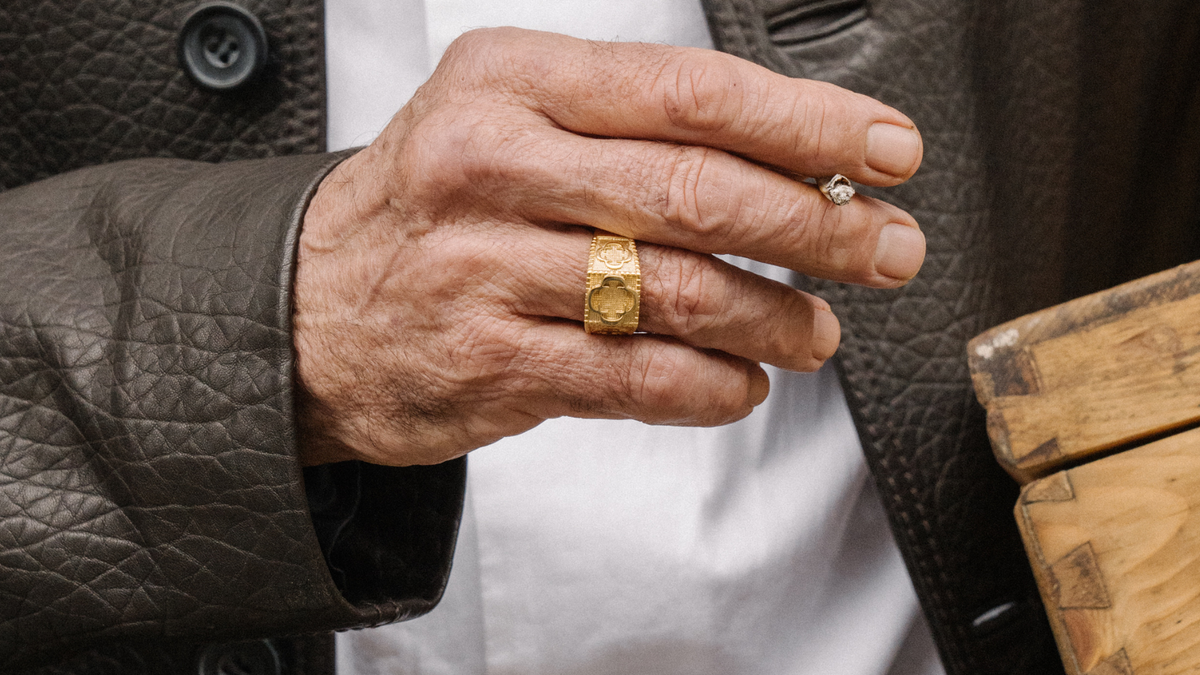
What Does It Mean When a Man Wears a Signet Ring?
A signet ring used to carry a man’s name. Now it carries something more personal: faith, heritage, a milestone, or simply the part of himself he wants to keep close.
Read more
What Is a Figaro Chain? The Story Behind an Italian Classic
The Figaro is one of Italy’s most recognisable chain styles, defined by its signature three-short, one-long link pattern. Here’s where it came from, what sets it apart and how to wear it.
Read more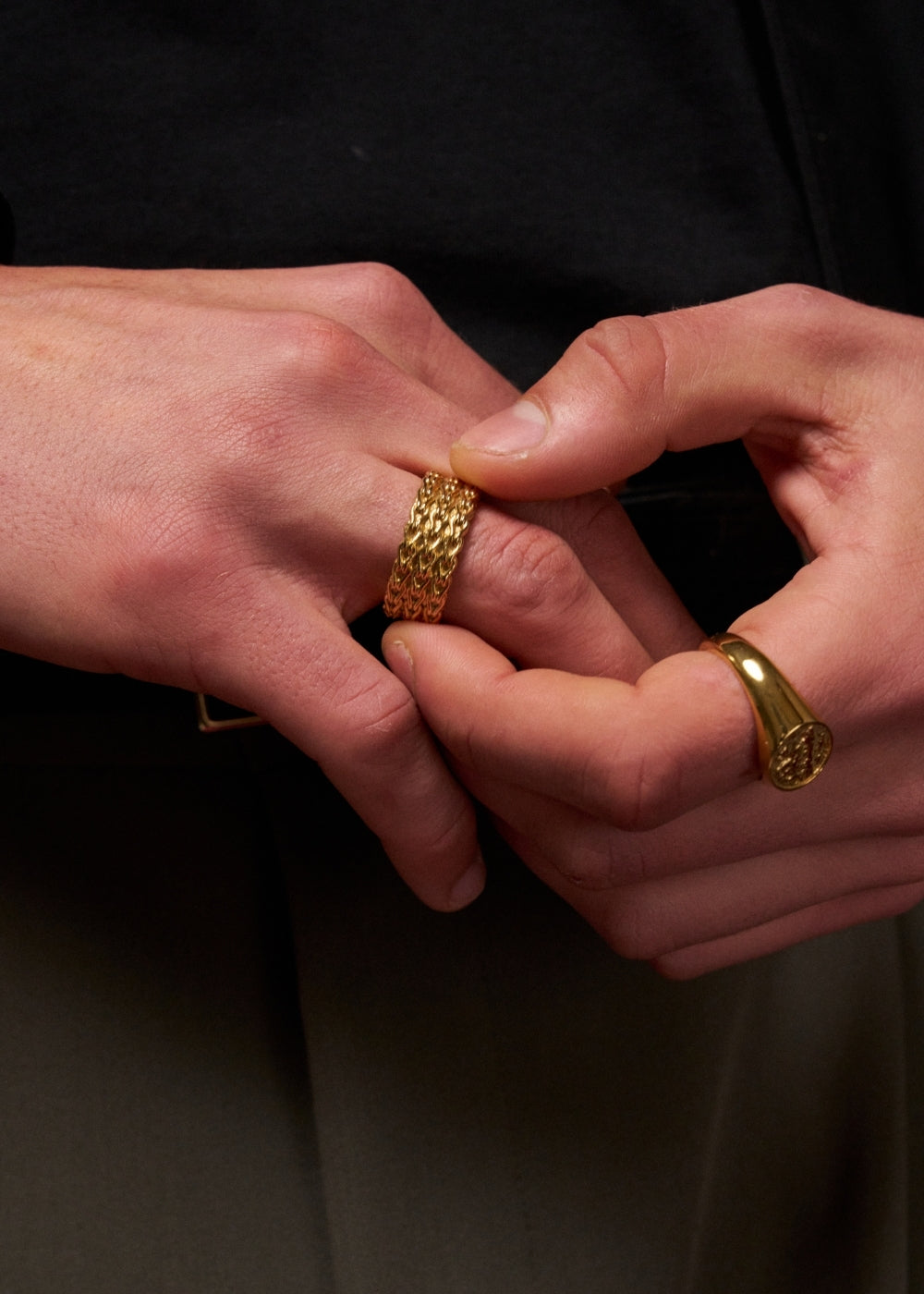


Leave a comment
This site is protected by hCaptcha and the hCaptcha Privacy Policy and Terms of Service apply.